
Why Asphalt Fails: A Stage-by-Stage Breakdown for Homeowners, Facility Managers, and Reporters Covering Infrastructure
Asphalt pavement doesn’t fail overnight. It moves through a predictable sequence of deterioration — one that pavement engineers can read almost like a timeline. Catch it early and a parking lot or driveway can be preserved for a fraction of the cost of rebuilding it. Miss the window, and a $200 crack-sealing job turns into a $20-per-square-yard reconstruction project.
OZ Paving, a commercial and residential asphalt contractor serving Northern Colorado (Loveland, Fort Collins, and Estes Park), built a visual Damage Guide to help property owners identify exactly where their pavement sits on that timeline. This article distills that field guide into a reference any writer, blogger, or property manager can use to understand — and explain — how asphalt actually breaks down.
The Four Root Causes of Pavement Failure
Before cracks and potholes ever appear, asphalt is already under attack from four directions at once:
- Heavy traffic and axle loads. Repeated loading from vehicles — especially trucks — creates cumulative stress and fatigue cracking. Over time, rutting develops and micro-cracks propagate into structural cracks as the aggregate interlock that holds the asphalt mat together begins to fail.
- UV exposure and oxidation. UVA and UVB radiation drive photo-oxidation at the surface, breaking down the asphalt binder’s polymer chains. The result is surface decay, pitting, and the fine “spiderweb” cracking that signals an aging surface.
- Water intrusion. Once cracks reach the surface, water penetrates the base and sub-base. Subterranean flow erodes support material and grows voids beneath the pavement — the underlying reason so many potholes seem to “appear overnight.”
- Freeze-thaw cycling. In climates like Colorado’s Front Range, water trapped in cracks or the base freezes and expands, then thaws and contracts, repeatedly. Each cycle widens existing cracks and accelerates every other failure mode on this list.
These four mechanisms rarely act alone — a crack caused by traffic stress becomes the entry point for water, and freeze-thaw cycles turn that water into a wedge that pries the pavement apart.
The 6 Stages of Asphalt Deterioration
OZ Paving’s field guide breaks the lifecycle of a paved surface into six visually distinct stages, each with a different recommended treatment:
| Stage | What It Looks Like | Recommended Service |
|---|---|---|
| 1. New / Renewed | Minimal to no oxidation or aggregate unraveling | Seal coat / slurry seal (preventive, as needed) |
| 2. First Signs of Aging | Some oxidation, discoloration, and tiny cracks | Seal coat / slurry seal; infrared spot repair |
| 3. Signs of Surface Wearing | Surface cracking, discoloration, unraveling | Seal coat / slurry seal; crack seal |
| 4. Patching Needed | Potholes and localized subsurface failures | Crack seal; patching |
| 5. Surface Failure | Severe cracking and unraveling, but the sub-base is still structurally sound | Mill & overlay |
| 6. Total Surface & Subsurface Failure | Severe cracking, rutting, low points, potholes, and unraveling throughout | Full remove & replace |
The pattern matters more than any single stage: the earlier a repair happens, the less invasive (and less expensive) it is. Stage 1 and 2 fixes are surface-level and preventive. By Stage 5 or 6, the sub-base itself has to be excavated and rebuilt.
A Suggested Pavement Care Schedule, By Age
Pavement age is a useful proxy for where a surface likely sits in that six-stage lifecycle, assuming average traffic and climate conditions:
- Years 1–3 (New, like-new, reconditioned, or overlaid): No routine maintenance expected. Monitor for emerging cracks, damage, unraveling, or signs of poor installation.
- Years 4–9 (Early routine maintenance): This is the window to invest in maintenance and double the asphalt’s lifespan — filling cracks to block water intrusion, seal coating to protect against UV and moisture, and repairing localized potholes or patches.
- Years 10–16 (Recondition): Macro crack filling, patching, pothole repair, and continued microcrack protection via seal coating or slurry sealing extend the surface further.
- Years 17–20+ (Remove, rebuild, replace): At this stage, surface milling and overlay — or full excavation of the existing asphalt and sub-base, replacement and compaction of the sub-base, and new pavement — is typically the only remaining option.
Repair Options, Defined
Coverage of pavement issues often uses these terms loosely. Here’s what each one actually means in the field:
- Seal coat / slurry seal: A protective liquid coating applied to the surface to block UV and moisture penetration — the asphalt equivalent of sunscreen and a raincoat combined.
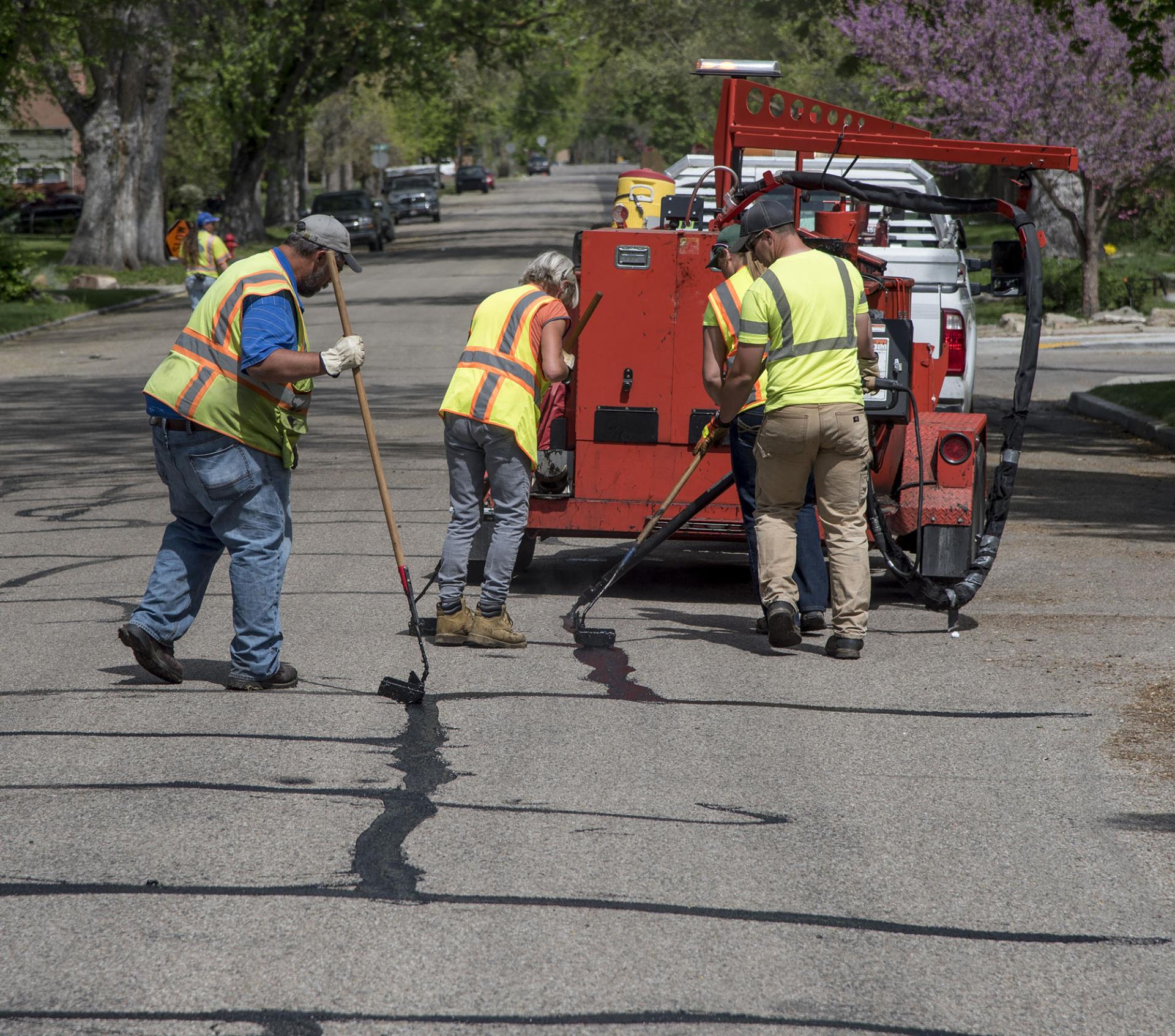
- Crack seal: A rubberized sealant injected directly into cracks to stop water intrusion before it reaches the base.
- Infrared patching: A localized repair method that heats the existing asphalt, allowing crews to blend new material seamlessly into the old surface without a visible patch line.
- Patching: Removing and replacing a damaged section of asphalt — the standard fix for potholes and isolated failures.
- Mill & overlay: Grinding off the top layer of worn asphalt and paving a new surface layer on top of a sub-base that’s still structurally sound.
- Full remove & replace: Complete excavation of the asphalt and sub-base, followed by rebuilding both from the ground up — reserved for pavement that has failed structurally, not just cosmetically.
The Takeaway
Asphalt deterioration is sequential and largely predictable, driven by four compounding forces — traffic load, UV exposure, water intrusion, and freeze-thaw cycling — and it moves through recognizable visual stages that dictate which repair actually makes sense. A crack sealed in year five is a maintenance expense measured in dollars per linear foot; the same crack ignored until year fifteen can mean a reconstruction project measured in dollars per square yard.
For the full visual reference — including annotated photos of each deterioration stage — see OZ Paving’s Damage Guide. Property owners in Northern Colorado who want a professional assessment of where their pavement currently stands can request a quote directly from OZ Paving’s team.
